


Listen on Spotify, Apple Podcasts or YouTube.
This essay is a companion piece to this episode of the Reversing Climate Change podcast, which you can listen to here on Substack (ad-free for paid subscribers coming soon), on Apple Podcasts, or right below on Spotify. There is also a previous episode that this post is a sequel to.
Everyone gets stuck on Weimar inflation
CW: this episode discusses genocide
People reference the Weimar Republic's transition to Nazi Germany often. But I think they're missing perhaps the most relevant and frightening insight from Adolf Hitler's memoir, Mein Kampf.
It isn't just that economic uncertainty produces political radicalism. It's that bad things can happen when a group which has dominated a multiethnic empire for a long time is expected to start sharing more political and cultural power with the groups they once ruled.
The overwhelming climate relevance of Charlie Chaplin’s speech from The Great Dictator

How a poetry episode for the Reversing Climate Change podcast accidentally ended up as an hour-long riff on Hitler, political comedy, and why we are ruled by madmen.
People really, and I mean really love to make comparisons to the Nazi Germany. They also like to point to the Weimar Republic which preceded it. And fair enough. There are rhymes to be heard.
The comparison I have most heard in an anecdotal twenty years of being politically online (besides letting anything broadly authoritarian fall into the Godwin’s Law bucket), is that after World War I, Germany was so exhausted by the war itself, reparations from the Versailles Treaty, and then the subsequent hyperinflation that average people could not take care of their families. Germans turned to more radical political ideologies both left and right as a result of raw hunger.
Without a doubt, this is a true insight. When the system cannot help you in your most basic needs, you start wondering “how good could this system really be?” At some point, one has nothing to lose but one’s chains.
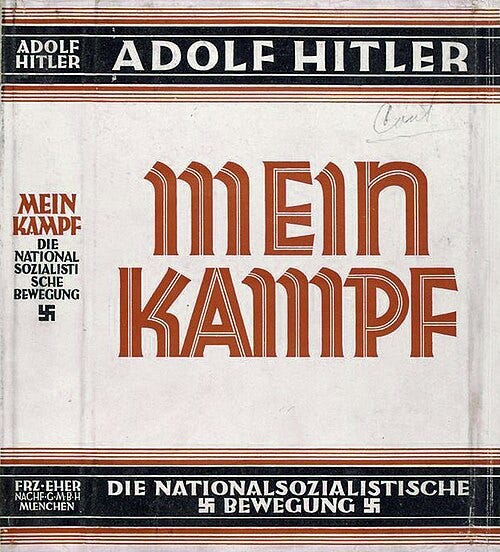
But I actually do not think this is the core insight of Adolf Hitler’s two-part memoir, Mein Kampf (1925-1926.)1 Hitler’s complaints about the Habsburg State (call it Austria-Hungary if you’d like) have an eerie ring to them the present-day United States, and I will explain why.
When multiethnic empires become pluralistic
“The process of the Slavization of the Austrian State was advancing year by year... the general development was directed against the Germans.”
— Adolf Hitler, Mein Kampf
I’m fascinated by what the Habsburgs were able to build and how it was able to evolve. They clawed their way out of the shroud of history in the 10th century as pretty much all “royalty” does. Somehow they had gotten a hold of same land and some peasants in what is now Switzerland, did some fancy genealogy that showed their bloodline Forrest Gumps itself somehow to the Jewish Patriarchs, Homeric heroes, Augustus, Constantine, probably King Arthur and Prester John and God himself if you gave them half a chance. Eventually they rule from Vienna.
The Habsburgs are famous for marrying their way to the top and “conquering” Europe through marriage. There was a period in Habsburg history where Habsburgs controlled the Holy Roman Empire all the way to Spain and the Spanish New World. Much of that was done through strategic marriages and personal unions that would consolidate titles and land holdings in the Habsburg family.2
The long 19th century complicated things for empires. It pains me to compress down such a big story and have to skip religion, the Dual Monarchy, and a bunch else, but the combination of mobility, literacy, industrialization, state capacity, bureaucracy, and about ninety other factors gave rise to new kinds of nationalism.
Much of this new nationalism can be located within Romanticism, and it had a strongly linguistic component to it. That can be both liberatory and punitive. You become French by speaking French as taught in free and compulsory public schools and as approved by the Académie Française. Give up your Gascogne or Occitan dialect and become “French”.3 Or, if you are a Lithuanian dominated by Polish cultural elites or the Russian state has banned your language, borrow Czech orthography to create your own written script and have book smugglers bring you texts in your vernacular to (re)build a nation around.4
A language is a dialect with an army and a navy.
— Max Weinreich
Errors of reading history from the present, by way of Ottomanism

If you’re an empire during this time, you’re watching the subject peoples you rule start to experiment with nationalism, and you actually don’t know yet that the nation-state will soon become the dominant political form. It probably looks ridiculous that these provincial Serbs or Walloons or Ruthenians or Lithuanians would govern themselves instead of a dynasty with centuries of practice wielding power. If they were ever good at it, they’ve been conquered and ruled by others for long enough to be out of practice. This nationalism thing—it’s a fad, like the internet would later become.
That being said, it might be nice to nip nationalism in the bud. And some empires tried harder than others to get ahead of what would later become history.
One of my favorite examples of this was a movement called Ottomanism. The Ottomans were ethnically Turkic steppe horsemen who settled down in Constantinople and expanded over centuries into the Balkans. They were able to Islamize some places more successfully than others (Bosnia, Kosovo, Albania), but also let Christians remain Christian and seek justice in their own courts for many matters if they paid the jizya and allowed some of their sons to be taken to become Janissaries.5
I studied abroad in Istanbul for a semester and took a class on nationalism while there. From what I can recall, I don’t think the Ottomans gave its ruled peoples a lot to get excited about. I don’t associate them with “Oriental cruelty” greater than their neighbors deeper into Europe, but there also just doesn’t seem to be a lot of identity available for a subject to adopt. By the middle of the 19th century, this strikes some Ottomans as a liability. So what if, and believe me, what if… we created our own imperial Ottoman nationalism that our subjects could opt into?
This has always struck me as a little, “how do you do, fellow kids?” but the Ottomans needed to find some way of generating some modern identity stickiness. The Ottomans tried to bring universal citizenship to its subjects6 that irked many Muslims who didn’t want to give up their culturally dominant position with co-citizens who weren’t coreligionists, and also irked many Christians who didn’t want to abandon their carveouts and relate to the Ottoman state as citizens same as any other. For those who did like this new identity, the fez hat became a symbol of Ottoman affiliation and identity.
Of course, things didn’t pan out for the sick man of Europe. The Ottomans were in a period of prolonged decline at least since Jan Sobieski’s cavalry charge at the Battle of Vienna, and dozens of Gallipoli’s couldn’t reverse that trend. It would be a mistake to see that as inevitable or even unique to them—it is totally possible that if we had skipped World War I, Ottomanism might have been a breakout hit—though I can’t say I liked its odds. However, the approach the Habsburgs took in trying to feed incipient nationalisms into their imperial politics had a better chance.
The Red Prince and Habsburg adaptability
The Habsburgs saw the same evidence that the Ottomans did. People were now all getting written versions of their language and becoming aware of themselves as agents of history with a capability of self-governance that stretched back into their noble pasts however long suppressed by their oppressors. How are you going to keep them in the Habsburg State once they have read the Kalevala?!7
The Habsburgs did several things to try to compensate, two of which I will cover, both of which will magnificently lead us back to Hitler.
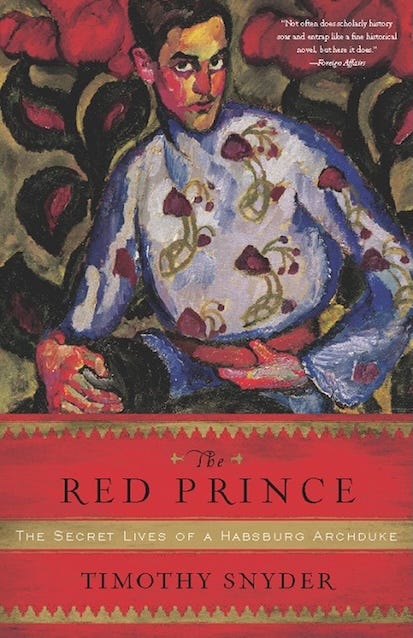
The first is documented in Timothy Snyder’s delightful book, The Red Prince: The Secret Lives of a Habsburg Archduke. It chronicles the life of Wilhelm von Habsburg who was born at the end of the 19th century to a Habsburg father who spoke fluent Polish and was, as far as I can tell, genuinely Polish in national sentiment. This probably sounds strange because it’s hard to think outside of the nation-state with how we have experienced nationality in our lives. But you’ll need to try.
A ruling family as big as the Habsburgs—which crosses so much of Europe—could build genuine loyalty and fellow feeling with their subjects by becoming the branch of royal family which adopted a nationality; learn the language, dress the part, and live amongst them.
If you know much about Poles and Ukrainians, you might know they aren’t always the best of friends (though they seem to be in a good place right now.) They overlap in a part of the world without many natural boundaries (and also the entire Yiddish civilizational zone) but hold plenty of different ideas about who should rule and where. Wilhelm’s father, as a particular type of Polish nationalist, doesn’t have the highest opinion of the Ukrainians.
Wilhelm, rebellious and bright son that he is, gets hooked on the Cossack mythology and the movement for Ukrainian independence and tries to bring them into the Habsburg fold before and during his fighting in World War I. He very much becomes Ukrainian. There’s almost a sense for these imperial figures where you can say something like “Wilhelm converted to Ukrainianism” in a way that doesn’t really make sense to how our brains process nationalistic understanding in 2026.
Now, imagine for a moment that you are an Austrian of German ethnicity who struggles financially and is obsessed with Wagner’s use of Germanic and Norse mythology in his operas. You are raised during the period of Romantic nationalism that stretches your people’s past back very far, perhaps even far enough back to reach to the Aryans of India. And you are ruled by ethnic Germans who are also LARPing at being Polish and Ukrainian while you have to go and get mustard gassed at Ypres?! Why aren’t they fighting with and for actual Germans?! Their focus is so split that they forget they are Germans and they send us to die in the mud and we cannot even claim it is for the glory of the German people.
By my lights, these imagined Hitlerian thoughts ring true to his character. It might be the bias of my life of living through so much populist rhetoric influencing how I wrote this, but this nationalist offense at the out-of-touch elite denying his true ethnicity in order to pretend to be and seek praise from an “inferior” people? Be an American and tell me you haven’t experienced someone share rage of this flavor. This is an echo.
Interethnic meritocracy and its discontents
“The process of the Slavization of the Austrian State was advancing year by year... the general development was directed against the Germans.”
“Did not we boys already know that this Austrian State had, and could have, no love for us Germans? Our historical knowledge of the methods of the House of Habsburg was corroborated by what we saw every day... The Royal House were becoming Czech in every possible way; and it was the hand of the goddess of eternal justice and inexorable retribution that caused the most deadly enemy of Germanism in Austria, the Archduke Francis Ferdinand, to fall by the very bullets which he himself had helped to cast. And he was the chief patron of the movement, working from above to make Austria a Slav State!”
— Adolf Hitler, Mein Kampf
The second way (of many) that the Habsburgs tried to get ahead of nationalism was to include more meritocracy in governance. If you want people to experience their government as something that is a part of them rather than something external that sits on top of them, making sure that those who deserve a role by their qualifications should have it independent of ethnic identity.8
By doing so, it makes the empire seem less like ethnic Germans conquered your ancestors and still do as they wish, and more like a large club of peoples who share a free trade zone, military, and bureaucracy because there are economies of scale and it’s genuinely good for all of us.
But if you’re a borderline lumpenprole artist forced into Viennese utilitarian paint jobs by necessity, these free trade and united-peoples-of-the-empire arguments may not be persuasive.
“In the North and the South the poison of the foreign races ate into the body of our nationality, and even Vienna was visibly becoming less and less a German city.”
— Adolf Hitler, Mein Kampf
Insofar as state jobs can be considered a form of political patronage, the Habsburgs deciding to give away jobs and seats to non-Germans stung to someone who was struggling and cared so deeply about being German. To elevate non-Germans in status and access at the zero-sum expense of Germans may have felt like a betrayal.
You see this meltdown completely when Hitler walks into the Reichsrat, the imperial Parliament in Vienna. Expecting a grand temple of German authority, he instead encountered the living, breathing reality of a multiethnic democracy:
“How immediately I was outraged at the wretched comedy occurring before my very eyes! Several hundred of these representatives were present. Some of the gentlemen did not even speak German, but instead their Slavic mother tongues or rather dialects! It was a gesticulating mass in frantic turmoil, shrieking and interrupting in every pitch of voice...”
There’s something so “why can’t you people just SPEAK ENGLISH?!” about that quote. And it is, all things considered, a minor form of intergroup conflict—certainly by Hitlerian standards. The goal is to prevent its advance beyond this point in societies that are transitioning from having an ethnic core to one which shares power and status among its many peoples.
How exactly is one meant to transition an empire formerly dominated by a single group into one that shares power with the people it used to rule? How can this be done without frustrating that original group to the point of prolonged fury? This is the key theme I could not unsee after reading Mein Kampf. It has stayed with me for a decade, and is a major question for anyone who wants to live in a world a country where we are genuinely neighbors and not adversaries. If we are to have a chance at maturing into the 21st century, we will have to become wise enough to develop personal gentleness and institutional health.
A concluding thought: what if WW1 didn’t start imperial collapse?
It’s hard to look at the world without nation-state eyes. We take it for granted. In some cases the nation-state was probably net liberatory. In many other cases, it all but guaranteed ethnic cleansing. But could Ottomanism have actually worked out had the Central Powers not lost WW1? Could the Pan-European Imperial Habsburg way have given enough to all nations to have resulted in less conflict and more prosperity for the multitude?
Maybe. It’s fun to play at alternative history. Would Hitler have been Hitler had World War I not happened? Or if the Central Powers won? Or even if the Treaty of Versailles were written differently? It is very possible. Hitler may have just been a racist loudmouth. Or maybe he would have adapted to an Austria-Hungary which had evolved beyond its Germanic origins into something broader and genuinely transethnic. If he felt more economically secure and less abused by the government which put him in the trenches, we might have skipped so much absolute grief.
I am not certain how we will mature as a civilization and as a species, but I am certain that it will require us to “bring about the kind of society where it is easier to be good.”9 What we are doing now shows no sign of reducing the intergroup conflict that can only produce misery.
Subscribe to the Reversing Climate Change Substack
Become a paid subscriber for bonus content and ad-free episodes
This Episode's Sponsor
EcoEngineers: a full-service advisory and consulting firm focused on carbon dioxide removal, decarbonization, and carbon markets
2026 EcoForums Training Series: Navigating Global Carbon and Fuel Regulations, Market Mechanisms, and Life-Cycle Analysis Fundamentals
Check out my new show, Climate Workers Anonymous
Full Transcript
Ross Kenyon: Hey, thank you so much for listening to Reversing Climate Change. This is Ross Kenyon. I'm the host of the show. The sponsor is Ecoengineers. Oh, Ecoengineers. What isn't Ecoengineers? I've had a really great vantage point of carbon dioxide. And so often I'll start talking with a company and they will say something like, oh, well, we've been working with ecoengineers for a while now, either trying to build this methodology or just trying to figure this project out, trying to get the quantification right, trying to figure this MRV out. That has happened to me so many times. And I've been glad to see them have so much success with so many companies in our space.
Ross Kenyon: Ecoengineers is essentially a consultancy that helps carbon removal tech and project developers get to market effectively. If you've ever started a company, one of the early decisions that you're going to need to make is which of these things can we bring in-house and which of these things do we need to pay consultants for? And often the conventional knowledge here is that it always makes sense to bring stuff in-house if you can. But I think bringing in very experienced consultants early on can save projects a lot of time and money.
Ross Kenyon: For instance, you might end up on the phone with David LaGreca. David's going to be on the podcast soon. And David has done, I don't know, dozens of methodologies within the voluntary carbon market. And if you could just get on the phone with David for a little bit, and you are trying to bring a new methodology or protocol to market, you have some new approach, you're a biochar project, and you're trying to figure out, given your technology, region, biomass availability, what is the best way for me to work within the options that I have available to me? That's a person that you could very easily be paired with. David will likely shave off time and money from what would otherwise be a process that is pretty overwhelming.
Ross Kenyon: And that's just the start of it too. ECO has been engaged with people I've known or worked with from everything from project design to the actual MRV plans, doing the LCA itself, registering the project, doing the diligence support, feasibility studies, tech evaluations, market eligibility. I feel like they're halfway to being an EPC without actually being an EPC for some of these things. Sometimes you don't necessarily need one person full-time thinking only about your projects. Sometimes it makes sense to get 10 people on a fractional basis who have worked on collectively hundreds or maybe thousands of projects. Whether or not that will be the way for your company to go, you'll have to take the calls to figure it out. And I very much think you should do that. The link is in the show notes. If you'd like to get in touch with Ecoengineers, tell them Ross Kenyon sent you.
Ross Kenyon: And also two quick points of really fun news. Rudy Krebiel is going to be on the show sometime soon. We've been scoping a show for so long. He's one of those friends of mine that are always trying to find the right container for a discussion between us. And because we speak so often, it always seems like you can delay and wait a little bit to do it. So Rudy's coming on soon. I'm really excited to have him on.
Ross Kenyon: The 2026 EcoForums training series that EcoEngineers is putting on is coming out soon. It's a carbon markets training. It's on July 28th. You'll get to hear how experts approach real world practical: how do we do carbon markets? How do credits work? Where they think the market is heading and how to turn those global carbon trends into a smarter strategy than what many people likely have now. If you're listening to this after July 28th, you can go to ecoengineers.us slash ecoforums. Link is in the show notes. Thanks so much for listening. Here's your show.
Ross Kenyon: Hello, Ross Kenyon here. I'm the host of Reversing Climate Change, the climate podcast that ends up finding links to everything else because, well, climate is connected to everything else. And if you only make a technical podcast, if you only make a business podcast, if you only make a policy podcast, one runs the risk of missing those connections that really help give one a robust understanding of how the world works.
Ross Kenyon: Do I have a robust understanding of how the world works? No. I think I'm halfway clever enough to know that this system is large and confusing. Supposing one grand system that will unlock or solve the world's problems is a great risk.
Ross Kenyon: There's a clip from one of my favorite shows of all time, Peep Show, maybe my favorite show of all time, where the two characters, Mark and Jeremy, are arguing because Jeremy has fallen into, if you heard the Diana Pasalka podcast I did recently, he fell into a new religious movement, one might politely say. Jeremy lays out that the presence or absence of an invisible entity called orgones are the source of all of humanity's problems. Mark doesn't believe him and says, I'll even read you the exact quote here, Jeremy. Well, how do you explain all the problems in the world? Mark, I mean, I couldn't. Just, there are so many historical and economic factors. Jeremy interrupts him. Exactly. You haven't got a clue.
Ross Kenyon: That scene has always cracked me up. And just the other day on LinkedIn, I saw a very famous philosopher post an article of theirs. The description of the article mentioned something about capitalism, and someone commented, the only way to reform capitalism is to do this one solution that I wrote a paper about here. And something about that just cracked me up.
Ross Kenyon: Capitalism is a bit like Hinduism. Prior to British, Portuguese, French colonization of the Indian subcontinent, there really wasn't a thing called Hinduism. There were just hundreds or thousands of religious practices of people devoted to specific gods and ways of understanding them. And sure, if you want to say that all of those individual gods are ultimately expressions of oneness and therefore they're part of the same pantheon and ultimately it goes back to some sort of Atman or Brahma and we're all involved in cycles of becoming differentiated and then blending back into this undifferentiated being and then back again. And you can call that Hinduism as a whole. Maybe there's enough connecting there to make that a useful way of understanding so many different beliefs.
Ross Kenyon: And capitalism is a bit like that too. We call it one word. There's various other things that you can say about what is capitalism that might make it more descriptive, more useful. You could say something like late capitalism. If you say late capitalism, it's sort of pejorative in the sense that it has a critique built into the word, much like a favorite word of mine, schlep. There's no English word to that Yiddish word equivalent. Schlep has the complaint built into it. It's more than just carrying. You would need like 10 different English words to replace schlep. That's how good it is.
Ross Kenyon: Late capitalism implies that it's near the end of its life or that it's already dead and that it's zombified in some way. You could talk about fossil capital. In fact, if you drop the ism off of capitalism, we know you're working from a Marxian or heavily influenced by Marx political economy way of thinking. If someone says liberal capitalism, they're most likely talking about the world order as it basically exists right now. There's democracy and there's capitalism between liberal states, most of whom are nation states.
Ross Kenyon: But capitalism is also a process that's engaged in continuous churn. If you're alive right now, which is a really weird thing to say on a podcast where presumably you're listening to while alive, the world is changing very quickly right now. The capitalism of a year ago is different from the capitalism of today. The resources that are important today are different from the ones of a year ago. More and more questions are around what is the future of work? How will people be compensated in a world where productivity is potentially determined by access to compute resources and not purely around skills? And so we might say capitalism as a fixed, nominative thing, but it's actually a process with so much variability inside of it.
Ross Kenyon: If you're talking about the metropolitan core of capitalism, broadly where finished goods accumulate, capital accumulates, you're in the global north. That's one experience of capitalism. If you're on the periphery, mostly where the raw inputs of capitalism are derived from, your experience of capitalism is different. And it changes over time.
Ross Kenyon: I'm not trying to only be a pedant here about language and what it means to call something by a fixed-ism, when it's actually a historical process. And in fact, Marxists are pretty good on this one because they are process oriented thinkers. That's what historical materialism and being dialectical is about. It is about capturing a sense of change and evolution and not just a fixed thing. And not trying to be a pedant about big concepts and how much they can obscure rather than denote change and evolution.
Ross Kenyon: The show that I put out last week on Charlie Chaplin, The Great Dictator, and Adolf Hitler. The subtext there, and this was probably way too much and too ambitious of a show to broadly freestyle on, is that there's rarely one single way of understanding an issue. Even something as simple as who was Adolf Hitler turns out to be a really fascinating multivariant kind of question.
Ross Kenyon: I'm in the process of preparing a eulogy for a family member right now. If you have ever had to do that, then you know, how could you possibly tie up all of the different ways that this person was into a package that is entertaining, moving, or at the very least true. It's not easy. We have whole worlds inside of us. And Hitler does too.
Ross Kenyon: One of the parts of this show that I've been thinking a lot about is the way that I characterize the war aims of the Nazis in World War II. Even the way that I framed this misses a lot of useful nuance. So I had said something like the Holocaust represented a major distraction to Nazi war aims, but Nazi war aims were the Holocaust. The goal of Nazi Germany was to conquer and eliminate the Yiddish civilizational zone in Eastern Europe and the Slavic areas, and to replace them with good Teutonic stock. The Germans were not interested in merely conquering for the sake of resources and ruling over people and changing their government. They were interested in changing the racial and ethnic composition of Europe.
Ross Kenyon: If you were a careful listener, you could have retorted that the Holocaust was not a distraction from Operation Barbarossa in the East, the Soviets versus Germany. And it could not have been a distraction from the Atlantic wall and overlord in the West. Because it's impossible to separate the racial ambitions of Hitler from more quotidian conquering goals. The goal was never to conquer and rule the East for its resources or for its honor.
Ross Kenyon: One of the books on this topic that I really like is Timothy Snyder, who also gets a name check in this episode. His book, Black Earth, the Holocaust as History and Warning. His attempt to codify Hitler's personality and his character, I'm sure Tim has thought through so many options of how to understand Hitler and why, but he calls him a zoological anarchist. This is where people link Nietzsche to Hitler, is that Nietzsche thought that Christianity was a philosophy of the weak. It was used to put fetters on the strong and to sort of gaslight the strong into thinking that they had to respect the weak. But I don't think this has to have a conquering way of thinking for Nietzsche. My read of Nietzsche on this is that it's more about ideas. Do not let the ideas of the weak persuade the strong to not be strong. It doesn't necessarily mean that strong people have to conquer and brutalize others. You can read it that way, and there probably are quotes that push one that direction. But Hitler was definitely one of those people who has that read of Nietzsche.
Ross Kenyon: My understanding of Hitler is that he thought Christianity was a Jewish philosophy meant to corrupt the paganism of the Greeks and Romans, Germanic, Celtic, Norse peoples of Europe and confuse them. Hitler simultaneously viewed Jews as both strong enough to run the entire world in secret, financially, by media, but also a sort of a sniveling group of weaklings that had tricked these noble pagan strength worshiping people into being weaker than they needed to be. And his job was to cast that off. And so when Timothy Snyder characterizes Hitler and the Nazis as zoological anarchists, it's an attempt to return to a truer form of existence, a truer form of ontology. We've dressed ourselves up with civilization, but at its root, it's a war of all against all. To deny this is to lie to ourselves and to put one's race at risk of another race realizing this before you do and them acting against your race. The zoological being a return to animalistic, natural predation hunting.
Ross Kenyon: I've been watching the David Attenborough Our Planet, good grief, if you care about climate change, it's a hard watch. But even just the way that animals treat one another, you see things like orcas body slamming a baby gray whale. You're just like, man, nature is a beautiful thing, but it's also horrifying if you let yourself remember the horror of that and how it would feel if that was your child that you were watching this happen to. And Hitler is claiming that that's our true nature. We've gotten away from it. And now Germany is in a precarious position because of a Jewish philosophy that prioritizes kindness and meekness. And now is the time to throw off the old rules anarchistically and to zoologically reconquer what could be our entire territory.
Ross Kenyon: So is Hitler a zoological anarchist? I think it is one really useful way of understanding his philosophy. And if you don't have that in your box of tools for how to understand Hitler, it will cause you to make a mistake or at least a rhetorical oversight that I made in the last episode of trying to separate his war aims from his quote unquote extracurricular activities. But aren't each of them still useful in their own way? I think the job of understanding something as complex as a single person of this importance is to understand the role of texture and to try to note all the ways that they are and have been theorized and could be rather than trying to put someone in a box.
Ross Kenyon: You slap an ism on there and you start to mistake the map for the territory and start forgetting that there are many, many, many, many different ways to understand capitalism. There are many different ways to understand Hinduism and religion generally.
Ross Kenyon: Gosh, I think I might have mentioned this on another podcast recently, so I apologize if you've heard this one before. But I was in an art gallery recently. The artist who was in there, I was talking to him, religion came up in some way, and he was asking me some questions, and he was quizzing me on eschatology, and I had impressed him enough where he was like, oh, I'm talking to someone who knows. And this person was explaining to me the type of theology that he likes, and he says, we take the Bible at face value. And the image that kept popping into my head, man, my brain is just so mediated by media, so filled with references. There's a scene in It's Always Sunny in Philadelphia where Frank, Danny DeVito, tells Charlie that he's not feeling the acid and he's gonna take some more acid now. And Charlie goes, classic mistake, Frank, you're making a classic mistake. And that's how I feel about the idea of taking the Bible at face value.
Ross Kenyon: You can read the Bible and take it at face value, that what it says is literally true and there's no poetry or allusion. But to me, that might be the worst or among the worst ways to read the Bible, especially if you're familiar with Judaism and the Talmud, or even just sophisticated Christian understandings where you're like, this book is weird. It's so weird. There's so many ways to read it. And especially if you're familiar with the Talmud, even in a cursory sense, you have just thousands of years of brilliant people arguing about language and meaning and application. And the Bible is not a straightforward book. I think it's better for that. But with thousands of pages of primary text, and then I have no idea how many pages of secondary analysis of different religious traditions and just pure scholastic work, you cannot take this book at face value. I think if you only take it at face value, you're missing out.
Ross Kenyon: And the things I think you can take at face value are things that are very clear. Like if you're a Christian, I think you have to have some pretty hardcore logic to get yourself out of turning the other cheek. It's declared what you're meant to do, which is to be chaotically good levels of forgiving. You're supposed to be better than the world. You're supposed to be kinder, gentler, and almost disarmingly accommodating of the world's excesses and follies. Critical, yes. Violent? No. It's unclear to me, even in Christianity, whether or not self-defense is permitted. I am not even sure that it is. I don't know how you could read the words of Jesus and then you'd have to do some sort of highly elliptical thing to figure out how to make that work.
Ross Kenyon: There's never one way only to understand something. And if you can play with these interpretations, it should help you find texture and give you ways of sort of just wrapping around these things that will make them more visible to you and unlock the beauty and truth that lie inside of everything.
Ross Kenyon: To that end, I cut this out of the original recording because it was already long and I was trying to keep a sense of movement to it. But I did want to spend some time talking about Mein Kampf. If you've never read Mein Kampf, you don't have to. It's long, repetitive. I read it about a decade ago. It's one of those books, like all politician books, there's mythologizing and you try to present your ideas in the best possible light with the most noble motives and things of that nature.
Ross Kenyon: The part that stood out to me that made it so terrifying is not that hard economic times produce radicalism. That's often the message that people take from the Weimar Republic, the interwar government between World War I and World War II. In Germany, before the Nazis came to power, German soldiers came back from the front. There is basically no food. It's a very, very hard time. And people are pushed increasingly leftward and rightward. The system is not working. Therefore, they are looking for answers in more radical places.
Ross Kenyon: Adolf Hitler, as you probably know, was an Austrian. Ethnically German, but within the Austro-Hungarian Empire, the Habsburg State, Austria-Hungary, especially in the period of the dual monarchy where it is Austria-Hungary and not just Austria. The world is changing in the 19th century. Romantic nationalism is very big. What we take for granted now about how important it is to have a national mythology and an epic. These are being created slash fabricated in many different places for different ethnicities to build a national narrative around. Languages are being written down potentially for the first time and developing their own system of lettering called orthography, figuring out which accents to use. So a lot of this is happening for the purpose of supporting national cultures.
Ross Kenyon: And this is especially important for Austria-Hungary because it has many national minorities. And it's growing too. The Austrians expanded deeper into the Balkans. You know how this plays out with Bosnia and Sarajevo and Franz Ferdinand. And you have groups who are motivated by the romanticism of the 19th century and want their own nation states. They want to be free of empire and not be ruled by distant monarchs that they don't really care about. They want their own states led by their own people as defined from within nationalism.
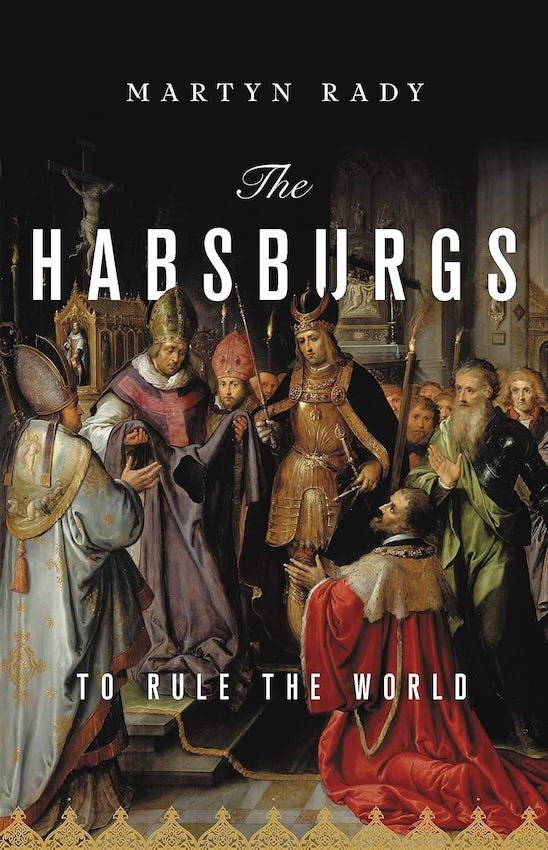
Ross Kenyon: Hitler, famously from Vienna. Poor nation. Struggling artist, ends up painting houses and doing odd jobs and doesn't have a great experience here. And during this time, he's watching the Habsburg state grow progressively weaker. And part of the reason why it's growing weaker in his understanding is because you had this German ethnic core that governed the Austrian state for a very long time. The Habsburg family, very old German Catholic family, married into pretty much all of the royal families of Europe. Seemingly, there's some Habsburgs in there. They sort of conquered the world, at least temporarily, just through marriage and personal union and dynastic politics. Really fascinating story. There's a good book on it called The Habsburgs that I would recommend.
Ross Kenyon: But Hitler as an ethnic German is watching this attempt by the Austrian state to involve its minorities more inside of imperial governance. There's a really great Timothy Snyder book called The Red Prince actually that talks about how various members of the Habsburg family would take on the dress and the language of the different regions and the peoples that they governed. They're trying to make the empire less of a visibly Germanic family rule, but also find reasons for the various peoples of the empire to support the empire for its own reasons, to see themselves in it. And that involves including more and more nationalities in the government and higher and more prestigious roles. And that this involves sidelining ethnic Germans to some extent. The empire was becoming less German and becoming more pluralistic.
Ross Kenyon: And Hitler is someone who's sort of a working class, struggling ethnic German who is watching his country and the state that governs him focus less on the German ethnic core that they've always been and include more quote unquote outsiders at the higher levels of culture and government. Really frustrated him.
Ross Kenyon: The part of Mein Kampf that I find to be most terrifying is, can you think of any other large states that have historically been ruled by a single ethnic group that over time includes more quote unquote minorities in government and culture such that the original ethnic group loses some of their relative influence and status that they once held in previous generations? Does that remind you of any place?
Ross Kenyon: I find the nationalities question, minorities question, to be a much scarier part of Mein Kampf than merely that economic uncertainty causes radicalism in different directions. The ideas around identity and what it's like to be part of a previously supreme ethnic group and then watching that influence decline and the right-wing reaction against that from those who are not ready or willing to share power in a more pluralistic environment. It's hard to stick that landing, I think. I remember various parts of Mein Kampf, but that is the part that when I think about the key message from it, the one that scares me to death is how many countries try to leave behind the dominance of one group and to share power and to do it in a way that is humane and does not provoke some awful backlash.
Ross Kenyon: Thanks so much for listening to this. Two episodes about history, about World War II, the Holocaust, Hitler. Because you could say historiography or just being able to work with multiple paradigms at the same time. I take for granted that some of these shows have obvious climate links to them. And maybe that's not so. Maybe you're listening and you're really struggling to figure out how this ties into climate change. What I would say to you is that climate is so connected to everything else on earth that we take it for granted. Being able to understand the world as a whole and different interpretations of it can only make you better at understanding, judging, and leading in a world that is undergoing increased climate strain.
Ross Kenyon: Like so many, I'm watching these El Nino predictions for later this year in 2027, and they look very bad. We need as many people who are kind and thoughtful about history, about how the world works, and to avoid falling into what seems like safety and to recognize falsity and to be brave in what we find beautiful. The world needs us to be kind and thoughtful leaders. To raise our voice in the right kinds of ways, to be compassionate, but also to draw a line. That the way the world is, isn't necessarily how the world should be. And that's why we care about climate.
Ross Kenyon: Philosophy, history, literature, film, these are not things that you do after work separate from your climate work. In my mind, these are connected. You could also understand me as being monomaniacal in a way. Like, why are you tying all of these things to climate work? Can't you just turn off and take a break? And I try to do plenty of that too, but so much of our, so much of the world's wisdom traditions point to how do we behave when times are bad? And why I keep doing this show is trying to point people towards, even if imperfectly, like I'm certainly not a saint and haven't mastered any of these things, but I try, I know it's the direction I should be pulling.
Ross Kenyon: That I think is what climate work is missing. I don't think we're losing on climate because we haven't invented the right technology or that we don't have the right policy or the right business model hasn't been developed. I don't think it's that. I think it's a much deeper issue here. And I think the answers are likely to come from the humanities and not from STEM.
Ross Kenyon: Thanks so much for listening. If you like this show, tell a friend you've got this so strange of climate podcast that you listen and you think they would really like it. Best place to follow the show is on Substack. If you're a paid subscriber, there's also subscriber chat so we can hang out over there. Link is in the show notes. Thanks so much for listening. Have a wonderful day.
You might disagree with this if you are wondering if/when the United States Dollar loses its global reserve currency status, but that’s a special kind of macro nerd/goldbug-adjacency that isn’t as common.
If you have heard of The War of Spanish Succession (probably because of pirates) but never taken the time to look into it (and who could blame you for that?), it’s the case of the Habsburg King of Spain dying and sending Europe into their genealogical charts and armies into the field. And sure, genealogy sounds like a boring hobby for the elderly, and it is, but I also do love it.
I actually recommended Eugen Weber’s Peasants into Frenchmen: The Modernization of Rural France 1870-1914 more times than I can count.
Not to go too far into all of the Timothy Snyder books I like in this post, but his book The Reconstruction of Nations: Poland, Ukraine, Lithuania, Belarus, 1569–1999 documents at length linguistic nationalism and some of its roots in Romanticism. Nations as composed of a people who speak a common language is one system of taxonomy that's been in vogue at least since the Treaty of Westphalia (though we usually see it hit its stride more with the American and definitely the French Revolutions). But much of the “history” that stretches deep into the past to find a coherent people is myth-making in the same kind of way described in the body text as the Habsburgs creating their fanciful genealogy. We build ourselves from story. One can take a DNA test or be a citizen of a country or speak a language or have matrilineal Jewish descent, but what that counts for and what one does with it are very different questions, because… we build ourselves from story.
If you want to get into the spirit, The Bridge on the Drina by Ivo Andrić is good. Some of its images remain with me years later. In fact, maybe I should go give it a reread…
This nomenclature changeover from “subject” to “citizen” that is now ubiquitous is also a product of nationalism and this historical process.
Before you respond pedantically here, I need you to know that I know the Habsburgs didn’t make it to Finland. Except, now that I mention this, I should probably double-check.
People generally point to the Imperial exam of China as an example.
The rightfully legendary Dorothy Day.


